

A few years before my father passed away at the age of 94, I wrote the following story for performance. This Memorial Day I reprint it here for him, and for all parents and offspring who struggle over the passing on of values and family traditions.
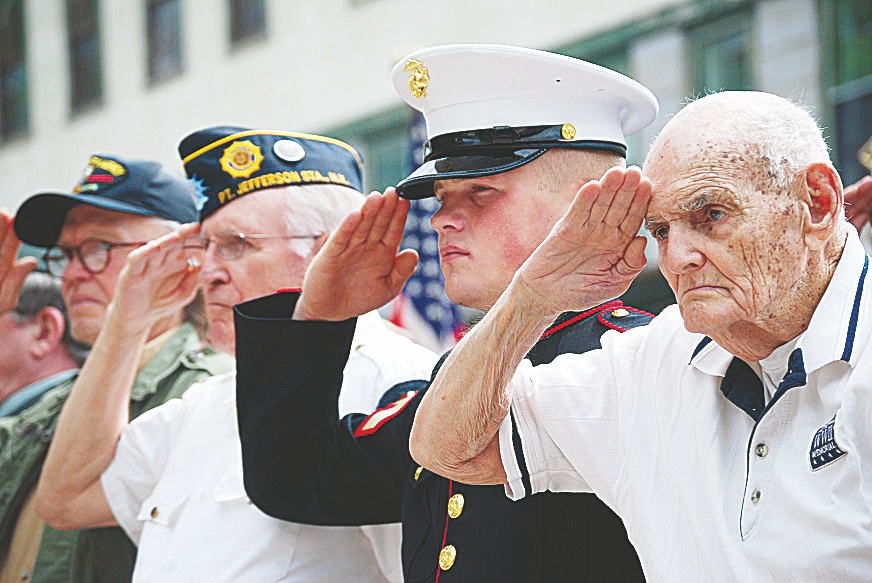
(Dad’s the handsome fellow on the right in the photo, at about age 90.)
When my father was a boy growing up in Sharon, Massachusetts, on Memorial Day his father would take him down to stand under the elms on East Street and watch the parade wend its way from the town hall to the Rocky Ridge Cemetery. The color guard would go by, with their flags flying, and then the junior high band passed, and then the veterans of the World War, and then the high school band, and the Spanish American war vets, and finally, riding in a convertible, sitting ramrod straight were two hoary-headed, wizened old men in ill-fitting uniforms that might once have been blue…the last surviving veterans of the civil war. And Grampa would look down at my father and tell him with pride “Allen, someone from our family has been in every war this country ever fought.”
Dad’s turn to carry on the family tradition had come along in 1944, when he joined the army the day he turned 18. He fought in Germany, in the Ruhr pocket and at Remagen Bridge and Ingolstadt and other places. When the war in Europe ended, he was transferred to the Pacific, and he was on a ship bound for a likely invasion of Japan when the Japanese surrendered.
When I was a boy, growing up in a series of small towns in Maine and other places, on Memorial Day my father would take me down to Elm Street or Main Street or South Street to watch the parade. And after the color guard has passed, and the Vietnam vets, and the junior high band, and the World War II vets, and the high school band, and the last surviving veterans of the First World War, Dad would tell me with pride “Andy, someone from our family has been in every war this country ever fought.”
The lesson he always taught me was that it was a privilege to be born in this country, and with that privilege came the responsibility of military service. That expectation was part of the furniture of my childhood, like the foot-long armored anti-tank shell we carted around to prop open the front door in every house we moved to.
The background noise of my childhood in the sixties and seventies was the war in Vietnam. The television was often on, so much that it was like another member of the family, a crazy uncle who sat in the corner of the living room making rat-at-at-at-tat noises and intoning body counts with the voice of Walter Cronkite.
When my time came, I broke the family tradition. Not only did I not join the military, but I marched, sat in and lobbied to stop the wars of my generation. This was how I wanted to live my life, but it kept me from honoring my father on his own terms, and honoring his service. This had to have been a disappointment to Dad, for a while… 20 years or so. I dropped into and out of a series of colleges, and spent a lot of time “gallivanting about” (as he put it), hitchhiking and sleeping under bridges, exploring the world without a uniform.
In 1984, when I was 22, I decided to spend some time in France to see whether my high school French would really get me from place to place and keep me from starving. (My high school French teacher, Madame LaRoche, always said “André, you are murdering ze language,” but she said it with a twinkle in her eye, so I thought it was worth a try.) So, I flew into Brussels, then hitched southeast toward Namur and the French border. For much of the route I followed the Meuse River, running a gauntlet of bluffs crowned with the castles and fortifications from a thousand years of war.
When I finally came to the first town in France, Givet, it was late afternoon and the rain that had been threatening all day had started to come down. I ducked into a drab café to collect myself. The only bit of color was a Charlie’s Angels pinball machine. I jotted some notes about the day in my journal, played a game of pinball while finishing my beer, then shouldered my pack and left to find dusk fast coming on the wet world outside. Walking along the road south, I had my eyes peeled for any possible shelter. As the road wound out of town and the stone houses grew further apart, I came upon a small garage right on the road with two doors leaning into each other on collapsing hinges, but slightly ajar. I figured I could sleep dry for the night, then get up and out early before anyone noticed me. I spread out my damp sleeping bag in the dust in the back of the garage, read for a few minutes by the dim light of my candle lantern, then snuffed it out and slipped further into my bag. I was asleep in no time.
I awoke who knows when to the sound of a car outside the door. I heard a car door slam, and everything got very bright in the light of car headlights as the garage doors swung open. I slid further into my sleeping bag and flexed my invisibility muscles, hoping not to be noticed. But I didn’t hear the car door open again, and I imagined the driver standing there staring incredulously at the giant blue nylon caterpillar in the back of his garage. Finally, he blurted out “Mais…C’est un garage privé!” (But….this is a private garage!”)
I feigned slowly coming awake, stuck my head out of the sleeping bag, looked up at the indignant grey haired man with his hands on his hips who was staring down at me, and stumbled through an apology. By then I was practiced at ordering croissants and asking directions, but an apology was something new…in any language. This was good practice!
Hearing my accent, he asked if I was a foreigner.
“Oui, je suis américain.”
“Ah, bon… J’aime les américains assez bien.” (“Okay… I like Americans well enough.”) And he said “Bonne nuit” and left me. That’s all I saw of him. I was heading down the road toward Reims and Paris in the first light of dawn.
The memory of that night has come back to me from time to time over the years, but I never ascribed it any particular meaning. It did occur to me at the time that that man had given me the benefit of the doubt because of the role US troops played in liberating France at the end of the war.
I still believe that to be true. But as I revisit the memory, I put a personal face on those American troops; now I can see that it was recalling young men like my father and his comrades in arms that prevailed on this old man to pardon the intrusion of another young man in his private garage decades later.
My father’s 90 now, and his one remaining ambition is to be the guy sitting in the back of the convertible, the last living veteran of World War II. I’ve always been thankful to my father for the big things, for keeping me fed and clothed with a roof over my head and all that, but during the years when I was most aware of our differences, there’s a lot I’ve never thought to thank him for…like passing on to me the storytelling gene, or the sense of humor that gets me in trouble sometimes, or the male pattern baldness that keeps my head cool in the summer (and in performance situations), for raising me with the ethic that the privilege of being born in this country brings with it responsibility…and for so many little things… like a dry place to rest my head one long ago, half-remembered night on the road.


 Andy Davis, Storyteller
Leave a comment