

Somewhere along the road during my second annual bicycle storytelling tour in July, while trying to fruitfully occupy my brain without distracting myself from simultaneously scanning for roadside perils ahead and keeping my feet spinning, I came to a new conception of the show I was carrying with me and debuting from place to place.

(To catch you up, if you haven’t been following my recent adventures, the show was “Quixotic!”, my love letter to Don Quixote, which includes personal story, a brief synopsis, two scenes from the novel, a glimpse into Cervantes’s life, and a tale from recent history in which the novel has a salvific role.)
The epiphany I had while pedaling that day in the middle of my three-week circuit was that it could be helpful to conceive of “Quixotic!” as an ensemble production. It’s not enough for just me to be on my game; but the mad knight himself and Sancho, as well as a small handful of minor characters, have to be there ready to express themselves fully, convincingly, and distinctly for the show to really flower and flourish.
Among my several roles is that of director. As such, at my best, I hold each of my cast members with the care of a Waldorf teacher for her pupils, discerning how best to allow them to unfold and burgeon as individuals.
I thought the cast was complete, but during final rehearsals for the July tour I began to experience a slight flagging in audiences’ energy at the point just over halfway through the hour-long show in which I described Cervantes’s traumatic life. Conveying crucial background in a sort of micro lecture, the niggling realization dawned on me that the drop in energy could best be addressed with a dramatic entrance: The author needed to speak for himself! As I was laboring to get all six pieces of the production up and running in a creditable manner at once, the time and generative spark necessary to accomplish a feat as ambitious as to bring the creator of the Quixote to life and allow him to take the stage just wasn’t available. So, over and over again, I told the tale of his war trauma, captivity, and ultimate deliverance, while feeling like a pallid stand-in for the one who really should have been up there.
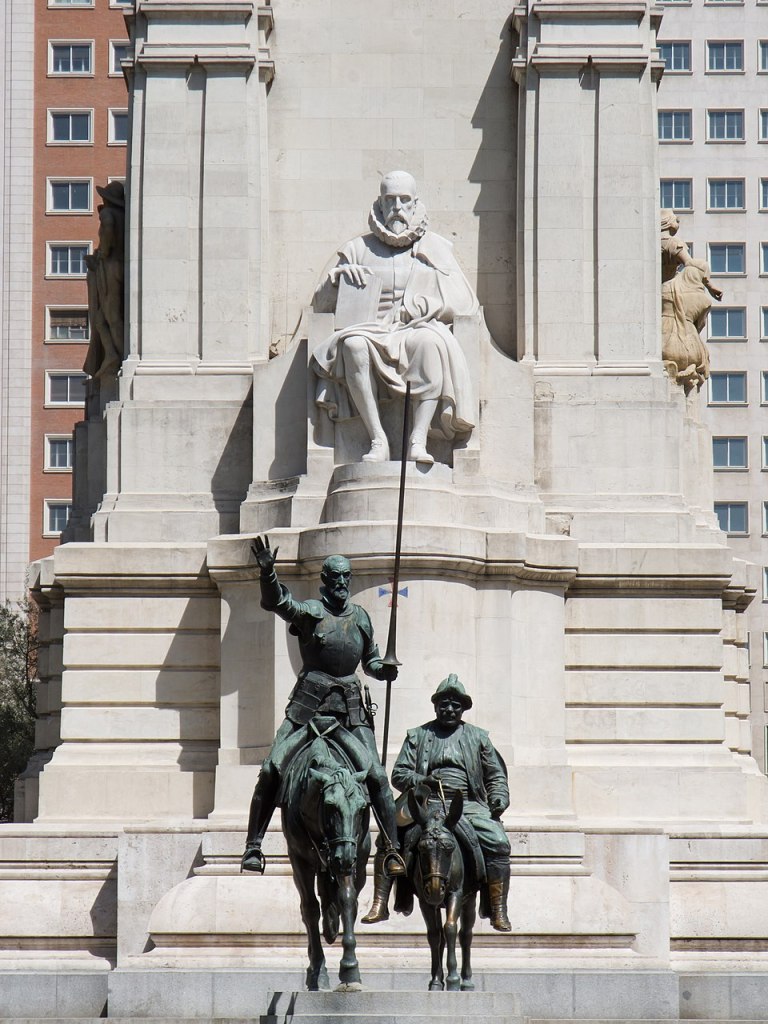
When, on the 29th of July, I finally pedaled the last leg home to my little home-made house in the White Mountains, after resting and writing a couple of dozen thank-you cards, my next challenge was clear: to add another member to the cast. Not just anyone, but no less than the very personage responsible for all of us having come together, the Father of the Modern Novel, a character of utmost consequence.
In any act of creation, we have to know when to ask for help; sometimes the director needs a director. I contracted Antonio Rocha, one of the storytellers I most admire, to help me make the leap. With his wizardry in the physicality of our art and transitions, especially, he’d already been hugely helpful in fine-tuning other aspects of the show. So, in two hours one afternoon in early October at his home in Gray, Maine, he helped turn Andy Davis into Miguel de Cervantes, (giving him gravitas and depth that I just don’t have!) and back again. Just like that, another cast member joined our little troupe!
At our best, as storytellers, we’re standing in for all of humanity, at least hinting at the tremendous variety of our human family, opening a little window to look out onto what our ancestors and siblings and those to come are capable of. When we work at our craft, and seek out the help we need, we can do that most fully, breathing all our characters fully to life as collaborators.
Cultivating the cast.

 Andy Davis, Storyteller
Leave a comment