

The Why and the How
“A stage for the ceili1, a machine for serving tea, the house is a tool for constructing community…”—Henry Glassie, The Stars of Ballymenone
******************************
More than any other thing, what made me a storyteller was the love of occasions in which humans gather together, look into one another’s eyes, and entertain each other. And for quite some time I have been a fan of house concerts, both as an audience member and as a performer. After two summers of doing bicycle storytelling tours, I’ve become an even more avid proponent. In the next few paragraphs, I’ll tell you why, and then get into the nitty gritty of how to organize, promote, and carry out such an event, for Andy Davis, for yourself, or for the performing artist of your choice.
Why?
“It was travelling northward Hanrahan was one time, giving a hand to a farmer now and again in the hurried time of the year, and telling his stories and making his share of songs at wakes and at weddings.” —William Butler Yeats, Stories of Red Hanrahan
******************************
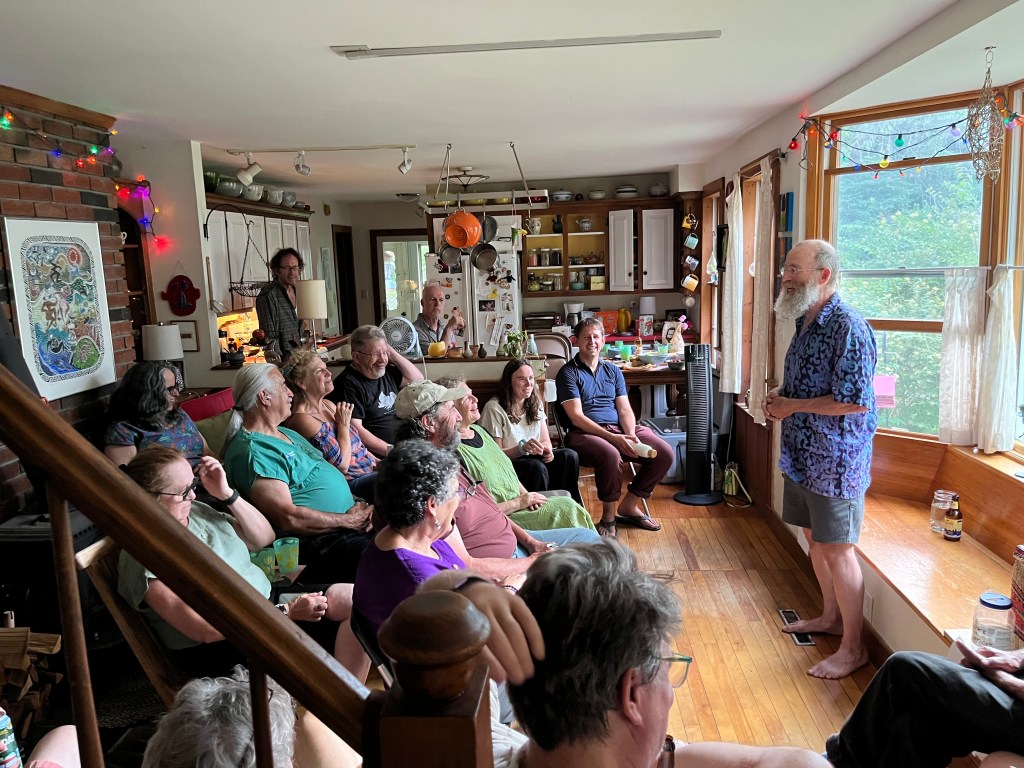
Let me start by confessing a fond nostalgia for the life of the traveling bards who would, for a glass (or two) of strong spirits and a place to lay their heads, position themselves at the humble hearth and tell stories till dawn. House concerts are very much in this tradition. They’re community events at the most grassroots level which harken back to a time when concert halls and comparable spaces did not exist.
House concerts expand the pie. By this I mean that they create focused cultural moments that wouldn’t have otherwise happened. They tend to be more economical than comparable events in formal venues, so they draw attendees who may not be in the habit of paying for live entertainment.
At the same time, they are in many cases more lucrative for the performer. In my experience, a host may cover their own small outlays from the proceeds, but after that the take goes to the special guest. In contrast, at a formal venue where what the performer receives depends on ticket sales there’s a split. It may be 50-50 or 30-70, or some other formula, but the house takes its cut. That’s completely reasonable, but such an arrangement requires that you sell a lot more tickets for it to work out well for both parties. And if I’m somewhere that my reputation hasn’t reached the broader public, the venue has to do a lot of strong publicity to generate a solid result, something that may or may not come to pass.
A reasonable question, then, is “it’s easy to see why the entertainer would love a house concert, but what’s in it for the hosts?” So glad you asked. Well, for starters, there’s the satisfaction of supporting the arts…and a favorite artist. But on a deeper level, I have witnessed a buzz that comes from having crafted a unique event for neighbors and friends, a glow that comes from having done one’s part to bring people together. This is a special kind of “social fabric activism,” and many people, sometimes even those who were hesitant at first, really grow to relish it, to completely inhabit the idea of their house as “a tool for constructing community.”
How?
“If every riddle was as easily unravelled as that life’d be heaven.”
—Éamon Kelly, Ireland’s Master Storyteller: The Collected Stories of Éamon Kelly
******************************
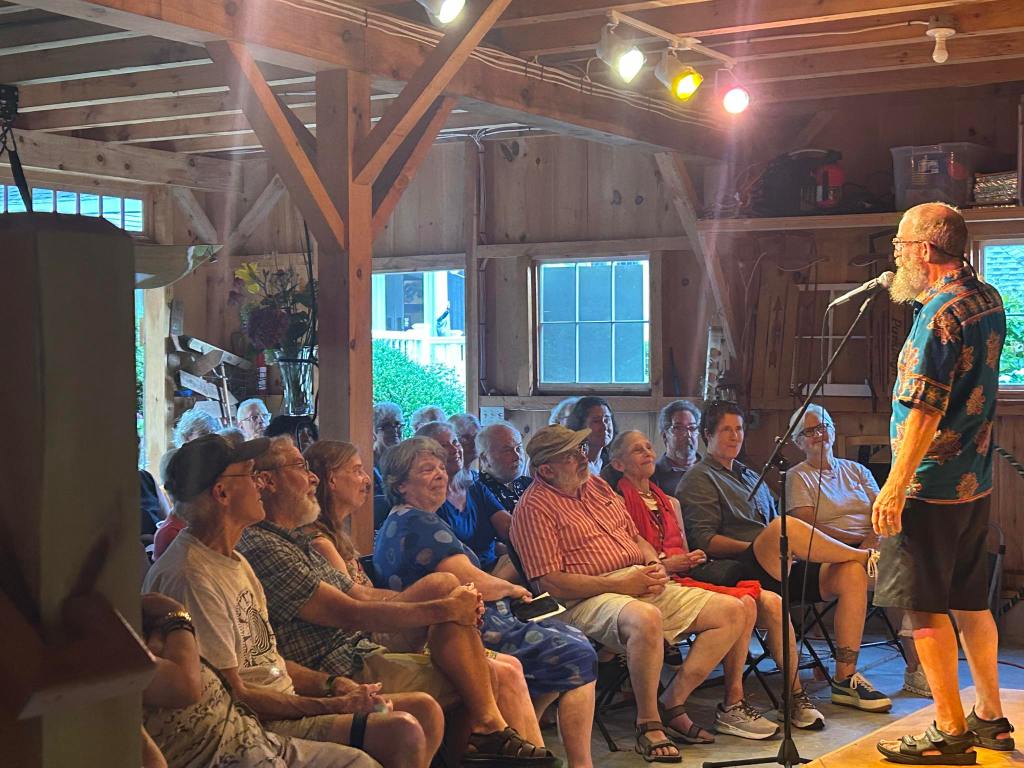
Once prospective hosts visualize and recognize that they have a space that can work, and that they have friends and acquaintances they can invite, the first order of business is to pick a date and time.
After the date and time have been picked, the first job, ideally at least a month out, is to begin publicity. In order to get started, it is necessary to determine how public the hosts wish to be. It’s one thing if the location is a known event barn or a public studio, for example, but prospective hosts often have an understandable reluctance about publicizing their private home address. One way to deal with this is to cast the net exclusively among “fish” they already know, and the performer’s local contacts. Another, if there is to be any public or semi-public outreach (such as a Facebook event) is to simply list the town in which the event is occurring and then give the actual street address only to those who RSVP.
Social media, email lists, texts, and other online outreach can be augmented with flyers and press releases, depending on everyone’s comfort level and provided there is consistency in safeguarding the address. Most people need to hear about an entertainment option multiple times to clinch their attendance. I generally provide hosts with a press release template and other publicity materials.
The host should know what their seating capacity is, and keep careful track of RSVPs so as to be able to cap it and start a waiting list if necessary. That being said, I recommend capping it at a number slightly higher than your capacity as, despite best intentions, there will be no-shows. For example, accept 35 reservations if you consider 30 to be your maximum comfortable seating capacity.
Another consideration is whether or not there will be a potluck before the concert. The collaborative meal adds to the community-building nature of the event, if the hosts are open for the additional minor complication of that. Generally, scheduling the potluck an hour before the performance time seems to work.
Knowing that this is far different from an event with a set fee, the performer should nonetheless have a clear (hopefully realistic!) idea as to what they’re hoping to bring in at each event. AND I tell hosts not to be debilitatingly concerned about the bottom line, as there are outliers on the high side, and outliers on the low end, and they tend to balance out over time. As for what to charge, it’s good to consider what the local market seems accustomed to and able to bear. This year, in New England, we suggested $15 in most localities and $20 in some. Have a large jar, pitcher or basket on hand, something that can be easily seen inside of. Position it prominently before the event, near the entrance, possibly with a friendly, welcoming person seated beside it. Pass it at least once through the crowd once everyone is seated.
A couple of additional considerations: If the weather allows, holding the event outside can be pleasant, as long as there is sufficient space in an undistracting area, adequate outside seating, and a back-up plan of moving inside in case the weather changes or the bugs get ravenous.
If the performance is so be inside in a contained space with not much more than twenty audience members, a sound system may not be necessary, but a larger audience, particularly outside, may require amplification. Often a system can be borrowed, or rented from a local music store.
And where does the tired star find sustenance and lay their weary head when the evening is successfully concluded? As part of the arrangement, from the outset, I ask my hosts to feed me and put me up in their most humble guest room. So far, I’ve encountered consistently gracious hospitality and been made to feel very comfortable and at ease. Those without apparently straight cis male privilege may want to ask more questions in advance about their sleeping arrangement and the composition of the household.
Inevitably, I have left something important out of this cursory overview. Please let me know your thoughts, and any questions that come up. If you’re interested in bringing me to your lovely home, I look forward to working with you. If you’re putting together something else, I hope this information is useful.
Good luck!

1-Earlier on the same page in this wonderful book about life in a traditional Irish community, Henry Glassie writes, “This moment of exchange, when neighbors come through the night and gather at the hearth, is called a ceili (kay-lee)…The event is central, essential. Life, they say, is just a little ceili-a brief visit, a flight out of the dark, when the body is warmed and fed, when social connections are made in the world.” You also see the word spelled “ceilidh,” and it usually implies some combination of music, dance, and storytelling.
 Andy Davis, Storyteller